


WooCommerce vs Shopify: Which E-Commerce Platform Is Right for Your Business?
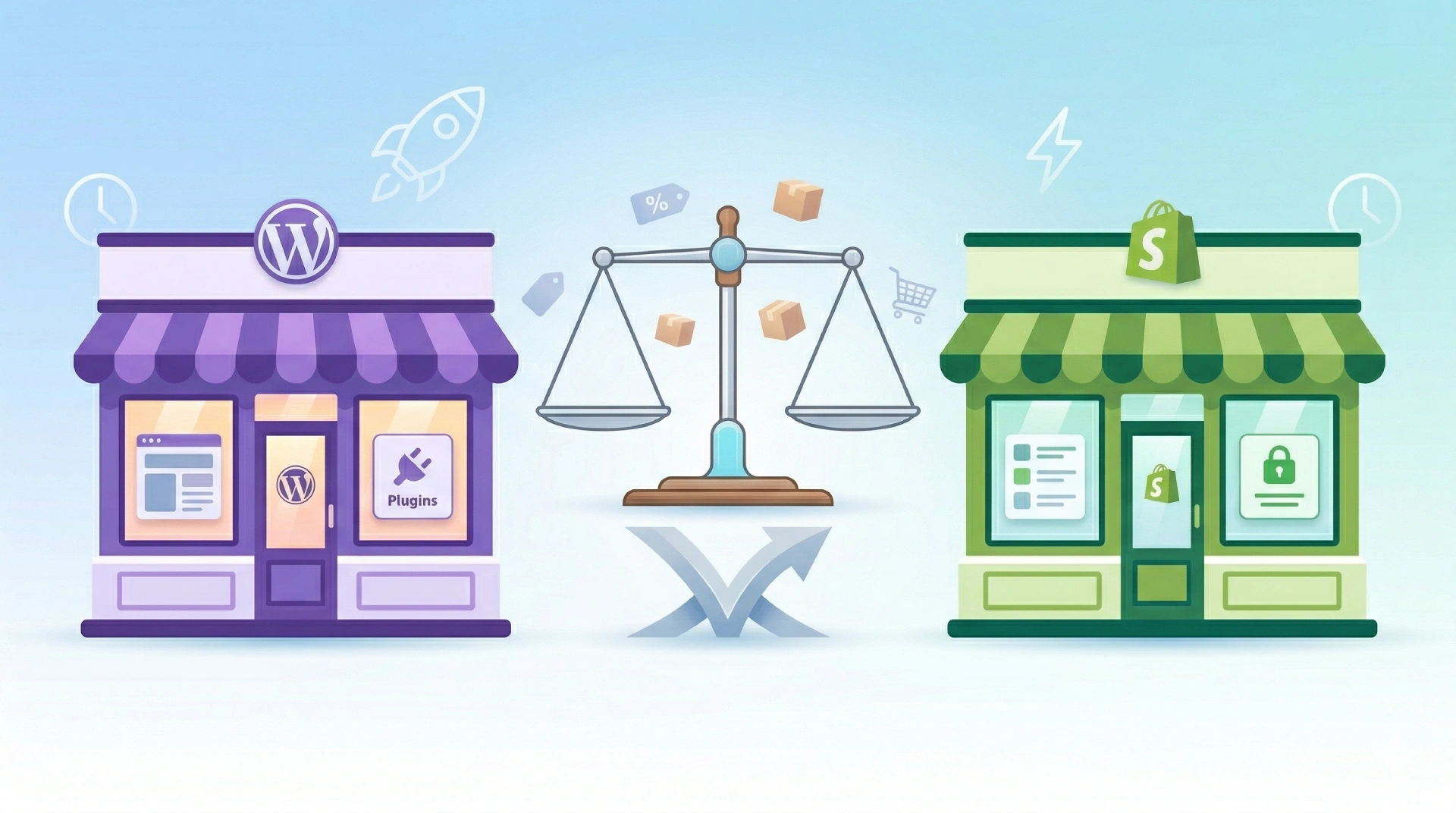
Table of Contents
Choosing the right e-commerce platform is one of the most important decisions you’ll make for your online business. Get it wrong, and you’ll spend months (and thousands of dollars) migrating down the road. The two biggest contenders — WooCommerce and Shopify — take fundamentally different approaches, and the right choice depends on your specific business needs.
As a WordPress developer who builds WooCommerce stores regularly, I’ll give you an honest comparison of both platforms — including where each one falls short.
The Quick Answer
Choose WooCommerce if you want full control over your store, need complex customizations, and plan to invest in a developer for the build. Choose Shopify if you want a simpler, managed platform where you can launch quickly without technical help. But the full picture is more nuanced than that.
Pricing: The Real Costs
Shopify
Shopify’s pricing looks straightforward on the surface: Basic ($39/month), Shopify ($105/month), and Advanced ($399/month). But the costs add up. Shopify charges transaction fees of 0.5–2% on every sale unless you use Shopify Payments. Premium themes cost $180–350 as a one-time purchase. And many features that should be built-in (like advanced reporting or abandoned cart emails on lower plans) require paid apps at $10–50+ per month each.
WooCommerce
WooCommerce itself is free and open-source. Your costs are hosting ($15–50/month for quality managed hosting), a premium theme ($50–100 one-time), and any premium plugins you need. Payment processing through Stripe or PayPal is 2.9% + $0.30 per transaction with no additional platform fees. For a typical small store, total monthly costs run $20–75 — often less than Shopify once you factor in app costs.

Flexibility and Customization
This is where WooCommerce wins decisively. Because it’s built on WordPress, you have access to the full codebase. You can customize every aspect of your store — from the checkout flow to the product page layout to the database structure. Need a custom subscription model, a unique shipping calculator, or integration with a niche CRM? WooCommerce can handle it.
Shopify uses a templating language called Liquid, which is more restrictive. While Shopify’s app ecosystem is extensive, you’re ultimately building within Shopify’s walls. If the platform doesn’t support something natively or through an app, your options are limited.

SEO: Which Platform Ranks Better?
WordPress (and by extension WooCommerce) has a significant SEO advantage. With plugins like Rank Math or Yoast SEO, you get granular control over meta titles, descriptions, schema markup, URL structures, sitemaps, and more. WordPress’s clean permalink structure and open architecture make advanced technical SEO implementation straightforward.
Shopify’s SEO has improved over the years, but it still has limitations. URL structures include forced prefixes (/collections/, /products/), you have less control over site architecture, and some technical SEO tasks that take minutes in WordPress require workarounds or custom Liquid code in Shopify.
Ease of Use
Shopify wins here. It’s designed for non-technical store owners who want to launch quickly. The dashboard is intuitive, product management is straightforward, and you can have a basic store running within a day without touching any code.
WooCommerce has a steeper learning curve. While the WordPress dashboard is user-friendly for content management, e-commerce configuration (payment gateways, shipping zones, tax rules) requires more setup. Most serious WooCommerce stores benefit from professional development — at least for the initial build.
Scalability
Both platforms can scale, but they do it differently. Shopify handles scaling automatically — their infrastructure manages traffic spikes and server resources. WooCommerce scaling requires upgrading your hosting, optimizing your database, and potentially implementing server-side caching. With the right hosting (like Cloudways or Kinsta), WooCommerce stores can handle thousands of orders per day without issues.
When to Choose WooCommerce
- You want full ownership and control of your store and data
- You need custom functionality that goes beyond standard e-commerce
- SEO and organic traffic are critical to your business model
- You already have a WordPress website and want to add e-commerce
- You’re willing to invest in a developer for the initial build
When to Choose Shopify
- You need to launch a store quickly with minimal technical help
- You prefer a fully managed platform where updates and security are handled for you
- Your store is relatively standard (products, cart, checkout) without complex customizations
- You don’t have a budget for a custom development build
The Bottom Line
There’s no universally “better” platform. Shopify is the easier path for simple stores and non-technical owners. WooCommerce is the more powerful choice for businesses that need flexibility, custom features, and strong SEO. If you’re unsure which platform fits your business, I’m happy to chat and help you figure it out — no sales pitch, just honest advice. Book a free call and let’s talk through your needs.