


AI Copywriting Tools for Small Business: A Shocking Review
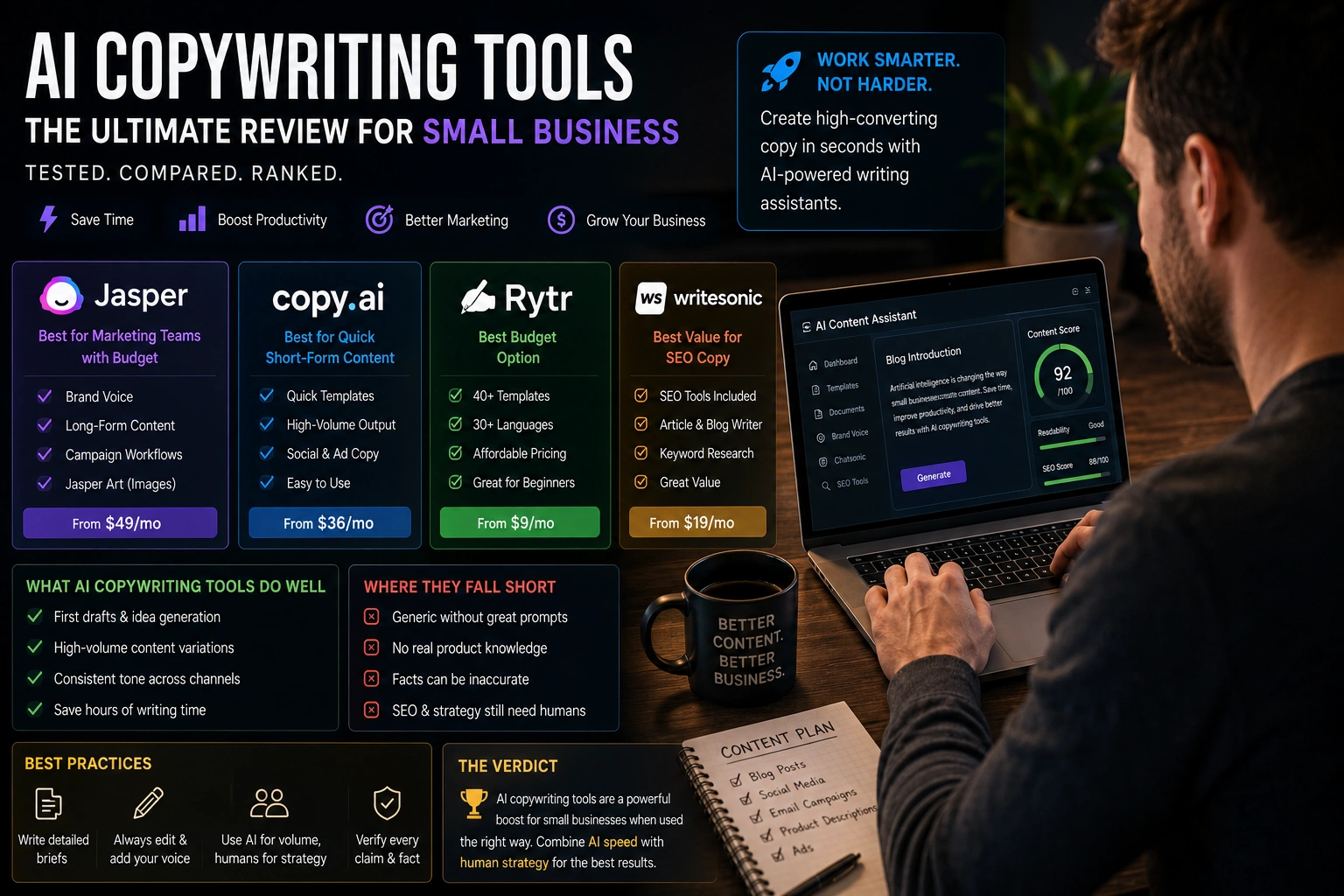
Table of Contents
I’ve spent the last several months testing every major AI copywriting tools platform I could get my hands on — and the results were not what I expected. Some of these tools genuinely impressed me. Others were an expensive waste of time dressed up in slick marketing. If you’re a small business owner wondering whether AI can handle your marketing copy in 2026, this shocking review covers what actually works, what doesn’t, and where your money is best spent.
What Are AI Copywriting Tools and Why Do They Matter?
AI copywriting tools are software platforms that use large language models to generate marketing copy, blog content, ad text, product descriptions, emails, and social media posts. Instead of staring at a blank page for an hour, you feed the tool a brief — your product details, target audience, desired tone — and it produces draft copy in seconds.
For small businesses operating without a dedicated marketing team, that speed matters enormously. The global AI content generation market surpassed $14.8 billion in 2024 and is on track to exceed $80 billion by 2030, according to recent industry research. That growth isn’t hype — it reflects real adoption by businesses that need to produce more content with fewer resources.
But speed means nothing if the output is mediocre. That’s the central question this review tackles: can today’s AI copywriting tools actually produce copy that converts, or are they just expensive autocomplete?
The Best AI Copywriting Tools for Small Business in 2026
After testing dozens of platforms, here are the tools that stood out for small business use cases — and a few that disappointed.
Jasper AI — Best for Marketing Teams With Budget
Jasper remains the most feature-complete AI copywriting platform on the market. Its Brand Voice training learns your tone, vocabulary, and style, which means output feels less generic than most competitors. The Creator plan starts at $49/month, with Teams at $125/month.
Where Jasper excels is long-form marketing content — landing pages, email sequences, and campaign briefs. It also includes built-in image generation via Jasper Art, which saves you from juggling separate tools. The downside? It’s expensive for solopreneurs, and the learning curve is steeper than simpler alternatives.
Copy.ai — Best for Quick Short-Form Content
Copy.ai has evolved from a simple writing assistant into a full go-to-market platform. For small businesses, its strength is speed: you pick a template (ad copy, product descriptions, social posts, email subject lines), enter your details, and get multiple variations in seconds.
The Pro plan runs $36/month, which is reasonable for the output quality. Copy.ai is ideal if you need high-volume short-form content — think social media captions, Google Ads variations, and email hooks. It’s less suited for long-form blog posts or in-depth articles.
Rytr — Best Budget-Friendly Option
At $9/month for the Saver plan and $29/month for Unlimited, Rytr is the most affordable AI copywriting tool worth using. It offers 40+ writing templates, supports 30+ languages, and handles about 80% of everyday copywriting tasks competently.
Rytr won’t blow you away with output quality — it requires more editing than Jasper or Copy.ai — but for small businesses watching every dollar, it’s a solid starting point. The free tier lets you test short-form content before committing any money at all.
Writesonic — Best Value for SEO-Focused Copy
Writesonic bundles AI copywriting with a chatbot, article writer, landing page generator, and basic SEO tools starting around $19/month. For small businesses that need content optimized for search engines, it offers exceptional value — SEO features like keyword research, readability scoring, and SERP analysis that competitors charge double for.
If your priority is creating content that ranks on Google, Writesonic deserves serious consideration alongside your broader content marketing strategy.
What AI Copywriting Tools Actually Do Well
Let’s give credit where it’s due. The best AI copywriting tools in 2026 genuinely excel at several things.
First drafts and ideation. These tools eliminate the blank-page problem. Feed in a brief and you get a workable starting point in seconds. For small business owners who aren’t natural writers, that alone can save hours every week.
Variations at scale. Need ten different subject lines for an email A/B test? Five versions of a Google Ad headline? AI handles this effortlessly. Generating variations manually is tedious and time-consuming — AI makes it nearly instant.
Consistency across channels. Tools like Jasper with Brand Voice training help maintain a consistent tone across your website, emails, social media, and ads. For small businesses without brand guidelines, this is surprisingly valuable.
Speed for time-strapped teams. A solo founder who previously spent four hours writing a weekly newsletter can cut that to one hour of AI-assisted drafting plus editing. That’s three hours reclaimed every single week.
The Shocking Truth: Where AI Copywriting Tools Fall Short
Here’s where the review gets honest — and where most AI copywriting tools roundups conveniently go quiet.
Generic output is the default. Without highly specific prompts, AI copywriting tools produce safe, bland marketing language that sounds like every other AI-generated piece on the internet. “Unlock your potential,” “take your business to the next level,” “in today’s fast-paced digital landscape” — you’ve seen this copy a thousand times because AI keeps generating it.
No real product knowledge. AI can’t interview your customers, use your product, or understand your competitive positioning from lived experience. Copy that converts requires deep understanding of your specific audience’s pain points, and AI simply doesn’t have that context unless you provide it in exhaustive detail.
Fact-checking is your responsibility. AI copywriting tools will confidently state statistics, make claims, and cite sources that don’t exist. Every factual claim in AI-generated copy needs manual verification. For small businesses without editorial processes, this is a real risk to credibility.
SEO requires human judgment. While some tools include basic SEO features, creating content that genuinely ranks requires strategic keyword selection, search intent analysis, and thoughtful content structuring that AI can’t fully automate. If you want your content to perform in search, you still need to follow a proven framework for writing blog posts that rank.
Google’s stance matters. Google’s helpful content guidelines make it clear that content should demonstrate genuine expertise and provide real value. Purely AI-generated content that adds nothing original is exactly what these guidelines target. You need a human perspective layered on top.
How to Get the Best Results From AI Copywriting Tools
The businesses getting real value from AI copywriting tools aren’t using them as a replacement for human thinking — they’re using them as an accelerator. Here’s the approach that works.
Write detailed briefs. The quality of AI output directly mirrors the quality of your input. A prompt that says “write an email about our sale” produces garbage. A prompt that specifies your audience, their pain point, the offer, the desired tone, and the call to action produces something usable. The brief matters more than the tool.
Always edit and add your voice. Treat AI output as a first draft, never a final product. Add your personal experiences, specific client stories, original insights, and genuine opinions. That’s what separates content that builds trust from content that fills space.
Use AI for volume, humans for strategy. Let AI generate your social media captions, email subject line variations, and product description drafts. Keep the strategic work — brand positioning, content calendar planning, campaign messaging — in human hands.
Verify every claim. Before publishing any AI-generated copy, fact-check statistics, confirm links work, and ensure claims about your products or services are accurate. One factual error can undermine the trust you’re trying to build.
The Verdict: Should Your Small Business Use AI Copywriting Tools?
After months of testing, here’s my honest take: AI copywriting tools are worth it for most small businesses — but only if you use them correctly.
If you’re a solo founder or small team producing content across multiple channels, a tool like Copy.ai or Rytr can save you meaningful time every week. If you’re running a marketing team and need brand-consistent content at scale, Jasper justifies its premium price. If you need SEO-optimized content on a budget, Writesonic delivers strong value.
But here’s the critical caveat: none of these tools replace the need for genuine expertise, original thinking, and human editing. The businesses that treat AI as a magic content machine end up with a website full of generic, forgettable copy that doesn’t convert and may eventually get penalized by search engines.
The winning formula in 2026 is clear — use AI copywriting tools to handle the heavy lifting of first drafts and variations, then invest your human time in strategy, editing, and injecting the authentic voice that only you can provide.
Need help building a content strategy that combines AI efficiency with human expertise? I help small businesses and startups create marketing content that actually drives leads and revenue. Get in touch and let’s build a system that works for your business.