


Headless WordPress Frameworks: The Essential and Shocking 2026 Comparison
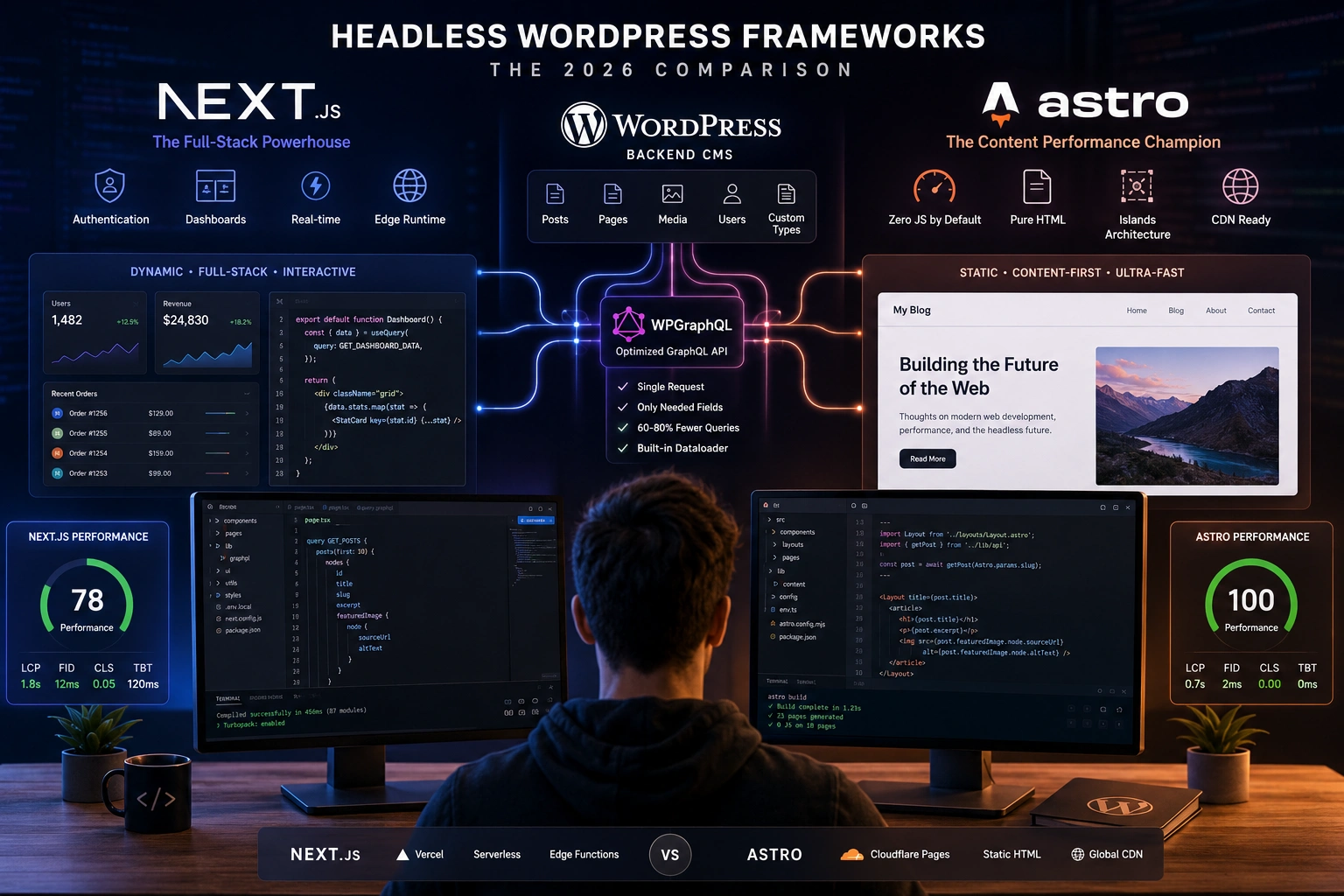
Table of Contents
The way we build WordPress sites is shifting fast, and headless WordPress frameworks are leading the charge in 2026. If you’ve been watching the decoupled architecture space, you’ve probably noticed that the ecosystem has matured dramatically — frameworks like Next.js and Astro now offer production-grade tooling specifically designed for headless WordPress. But which framework actually delivers the best results for your project? This essential comparison breaks down the top contenders with some shocking findings that might change how you choose your next stack.
What Are Headless WordPress Frameworks?
Headless WordPress frameworks are front-end technologies that connect to WordPress as a back-end CMS through APIs like the REST API or WPGraphQL. Instead of rendering pages with PHP themes, WordPress serves purely as the content engine while a JavaScript framework handles everything the visitor sees and interacts with.
If you’re new to this architecture, our complete headless WordPress guide covers the fundamentals — what decoupling means, when it makes sense, and how to set up your first build. This post builds on that foundation by comparing the specific frameworks you’ll choose between in 2026.
The core benefit is clear: you keep the editorial experience your team already knows while gaining the performance, flexibility, and developer experience of a modern JavaScript front end. And in 2026, the tooling around headless WordPress frameworks has reached a point where the trade-offs are far smaller than they were even two years ago.
The Best Headless WordPress Frameworks in 2026
The headless WordPress frameworks landscape has narrowed to four major players. Each brings a different philosophy to the table, and the right choice depends entirely on what you’re building.
Next.js — The Full-Stack Powerhouse
Next.js remains the most widely adopted framework for headless WordPress builds. With Server Components now stable, Turbopack as the default bundler, and mature edge runtime support, it handles everything from static blogs to complex authenticated dashboards.
The biggest advantage is ecosystem depth. Next.js has the largest community, the most WordPress-specific starter templates, and deep integration with hosting platforms like Vercel. Dedicated libraries like Faust.js make the WordPress connection even smoother. If your project needs dynamic features — user authentication, real-time updates, or server-side personalization — Next.js is the natural choice.
The trade-off? Next.js ships a React runtime on every page, which adds JavaScript overhead even for content-only pages where interactivity isn’t needed. That overhead translates to higher hosting costs at scale and slightly lower Lighthouse scores on purely static content.
Astro — The Content Performance Champion
Astro has emerged as the fastest-growing alternative among headless WordPress frameworks, and the results are genuinely shocking. Its core philosophy of shipping zero JavaScript by default is a structural advantage for content-heavy sites. Every page renders as pure HTML, with interactive components hydrated selectively through Astro’s “Islands” architecture.
A headless WordPress blog built on Astro typically scores 95–100 on Lighthouse without any manual optimization. Hosting costs plummet because static HTML served from a CDN is essentially free at any scale, while Next.js SSR requires compute on every request that costs money and grows with traffic.
For blogs, marketing sites, documentation, and portfolios, Astro delivers performance that Next.js can’t match without significant tuning. The trade-off is that Astro isn’t designed for highly dynamic applications — if you need authentication flows or real-time features, you’ll outgrow it quickly.
Nuxt and SvelteKit — Strong Alternatives
Nuxt 4 is the Vue equivalent of Next.js, offering SSG, SSR, and ISR with less boilerplate. If your team already works in Vue, it’s the most natural choice. SvelteKit delivers the smallest JavaScript bundles of any framework through its compile-time approach, making it ideal for developers who prioritize minimal payload above all else.
Both are excellent headless WordPress frameworks, but their WordPress-specific ecosystems are smaller — expect fewer starter templates and community examples compared to Next.js or Astro.
Headless WordPress Frameworks Compared: Performance and Developer Experience
When we line up headless WordPress frameworks side by side, clear patterns emerge across three key dimensions.
Performance. For content-first sites, Astro wins decisively. Zero-JS pages load faster, score higher on Core Web Vitals, and cost less to host. For dynamic applications with authentication and real-time features, Next.js is more capable out of the box. SvelteKit falls between the two with impressively small bundles and snappy transitions.
Developer experience. Next.js offers the most mature tooling and the largest ecosystem — if you hit a problem, someone has solved it. Astro provides a simpler mental model: write HTML with selective interactivity where needed. Nuxt and SvelteKit both offer clean developer experiences with passionate but smaller communities.
WordPress integration. Next.js has the deepest integration with WPGraphQL, which remains the preferred data layer for most headless builds. Astro’s content collections work beautifully with WordPress data too, though the ecosystem is newer. Both connect seamlessly to WordPress through GraphQL or the built-in REST API.
Choosing Your Data Layer: WPGraphQL vs REST API
Regardless of which framework you choose, you need a data layer to pull content from WordPress into your front end. The two options are the built-in REST API and the WPGraphQL plugin.
WPGraphQL 2.x is the preferred choice for most headless WordPress builds in 2026. It lets your front end request exactly the fields it needs in a single request — no over-fetching, no multiple round-trips. Features like automatic persisted queries and built-in dataloader batching can reduce database queries by 60–80% compared to equivalent REST calls.
The REST API still has its place for simpler integrations or when you want to avoid plugin dependencies. Kinsta’s deep dive on WPGraphQL vs the REST API is worth reading if you’re weighing the options. For most projects involving headless WordPress frameworks, though, WPGraphQL is the clear winner for both performance and developer ergonomics.
Hosting Your Headless WordPress Stack
A headless architecture splits your hosting needs in two. Your WordPress back end still requires reliable managed hosting — a provider like Kinsta handles security, performance, and scaling for your CMS so you can focus on building. For the front end, Vercel pairs best with Next.js, while Cloudflare Pages and Netlify excel with Astro’s static output.
The cost advantage of Astro for content sites is not marginal — it’s structural. Static HTML on a CDN is essentially free, while SSR compute scales linearly with traffic. Factor hosting costs into your framework decision, especially for high-traffic sites.
How to Pick the Right Headless WordPress Framework
Choosing among headless WordPress frameworks comes down to your project’s core needs. Here’s the decision framework I use with clients.
Pick Next.js if you’re building a full-stack application with authentication, dashboards, or dynamic personalization. The ecosystem is unmatched, and finding developers with Next.js experience is straightforward.
Pick Astro if performance is your top priority and your site is primarily content-driven — blogs, marketing pages, documentation, portfolios. The zero-JS default means exceptional speed with minimal effort.
Pick Nuxt if your team works in Vue. Pick SvelteKit if you want the smallest possible bundles and enjoy Svelte’s elegant reactivity model.
For most WordPress developers building client sites, I recommend Astro for content sites and Next.js for anything interactive. That covers roughly 90% of real-world projects.
Final Thoughts
The headless WordPress frameworks ecosystem in 2026 is remarkably mature. You no longer have to bet on experimental tooling — both Next.js and Astro are proven, production-grade choices backed by thriving communities and excellent documentation. The shocking takeaway from this comparison isn’t that headless works well now. It’s that choosing the right framework can mean the difference between a Lighthouse score of 65 and a perfect 100 — with less development effort, not more.
If you’re ready to make the move, start with the fundamentals in our complete headless WordPress guide, then pick the framework that matches your project’s needs. And if you’re looking for a developer who builds headless WordPress sites in production, let’s connect — I’d love to help you plan your architecture.