


5 Killer Email Segmentation Strategies for Stunning Campaign ROI
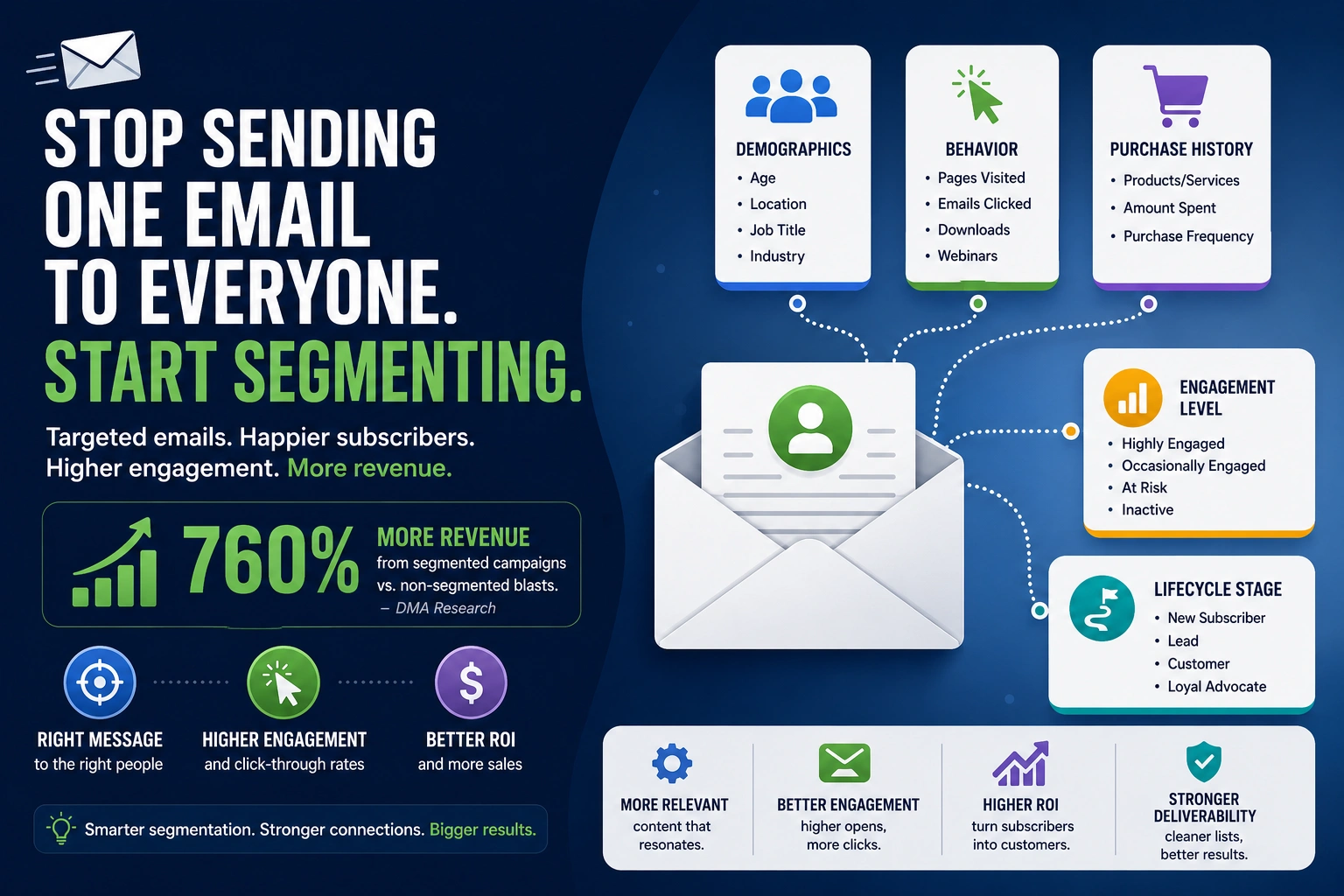
Most small businesses blast the same email to their entire list and wonder why open rates are tanking. The fix isn’t writing better subject lines or sending more often — it’s email segmentation strategies. Segmented campaigns generate 760% more revenue than one-size-fits-all blasts, according to DMA research. That’s not a typo. If you’re still treating your entire subscriber list as a single audience, you’re leaving serious money on the table.
In this post, I’ll break down five proven email segmentation strategies that will transform your campaigns from ignored inbox clutter into high-converting, ROI-driving machines.
Table of Contents
What Are Email Segmentation Strategies (and Why Do They Matter)?
Email segmentation strategies involve dividing your subscriber list into smaller, targeted groups based on shared characteristics — demographics, behavior, purchase history, or engagement level. Instead of sending the same generic newsletter to 5,000 people, you send tailored messages to specific segments that actually resonate.
The numbers make the case better than I ever could. According to Mailmodo’s segmentation statistics, segmented email campaigns see 100.95% higher click-through rates than non-segmented ones. Yet only 31% of businesses use even basic segmentation. That gap is your opportunity.
If you’re already building an email list from scratch, segmentation is the logical next step that turns subscribers into paying customers.
5 Killer Email Segmentation Strategies to Boost Your Campaign ROI
Here are five email segmentation strategies that work especially well for small businesses and service-based companies in 2026.
1. Demographic Segmentation
This is the simplest starting point. Group your subscribers by age, location, job title, or industry. A WordPress developer in Toronto has different needs than a retail store owner in Miami, even if they’re both on your list.
For service-based businesses, segmenting by industry or company size lets you tailor case studies, testimonials, and offers that feel personal rather than generic. If you’re a web developer, send ecommerce-focused content to your online store clients and portfolio-focused content to your creative agency contacts.
2. Behavioral Segmentation
Behavioral segmentation groups subscribers based on what they actually do — pages visited, emails clicked, downloads completed, or webinars attended. This is where email segmentation strategies get powerful because behavior signals intent.
Someone who visited your pricing page three times this week is far warmer than someone who hasn’t opened an email in two months. Send the first prospect a case study or consultation offer. Send the second a re-engagement campaign or a value-packed blog post.
According to Omnisend’s 2026 segmentation guide, behavioral segmentation is increasingly powered by AI, which surfaces intent signals before human marketers would even notice them.
3. Purchase History Segmentation
If you sell products or services, your transaction data is a goldmine for segmentation. Group customers by what they bought, how much they spent, or how frequently they purchase.
Past buyers are your warmest audience. Someone who purchased a website audit can be upsold into a monthly maintenance plan. A client who bought a starter package is a prime candidate for your premium tier. These email segmentation strategies turn one-time transactions into recurring revenue streams.
4. Engagement-Level Segmentation
Not every subscriber engages the same way. Some open every email, some click occasionally, and some haven’t opened anything in months. Segmenting by engagement level lets you tailor your approach to each group.
Your highly engaged subscribers deserve early access, exclusive offers, and premium content. Your disengaged subscribers need a re-engagement sequence — a compelling reason to come back or a clean exit from your list. Removing inactive subscribers actually improves your deliverability and sender reputation, which boosts results for your remaining segments.
With Apple Mail Privacy Protection inflating open rates in 2026, click-through rate is now a more reliable engagement signal than opens. Build your engagement segments around clicks and conversions rather than opens alone.
5. Lifecycle Stage Segmentation
Where someone sits in your customer journey should dictate what you send them. A brand-new subscriber needs a welcome sequence. A warm lead needs social proof and case studies. An existing client needs retention content and upsell offers.
Map your email segmentation strategies to these lifecycle stages: awareness, consideration, purchase, retention, and advocacy. Each stage calls for different messaging, different CTAs, and different value propositions. A well-built lifecycle email flow works around the clock, nurturing prospects and keeping clients engaged without manual effort.
How to Implement Email Segmentation Strategies With Your ESP
You don’t need enterprise software to segment effectively. Most email service providers — Mailchimp, ConvertKit, ActiveCampaign, and others — offer built-in segmentation tools that handle everything I’ve covered above.
Start with three segments rather than thirteen. HubSpot’s email marketing research shows that even basic segmentation dramatically outperforms unsegmented campaigns. A good starting framework is: engaged vs. cold subscribers, customers vs. leads, and one behavioral trigger like cart abandonment or content downloads.
Here’s a practical implementation approach. First, audit your existing data and identify which segmentation criteria you can act on immediately. Second, create your initial segments in your ESP and build automated workflows for each. Third, monitor performance for 30 days, then refine your segments based on actual results.
The key is starting simple and adding complexity only when your data tells you to. Over-segmenting too early spreads your content creation efforts thin and makes testing nearly impossible.
Measuring the ROI of Your Email Segmentation Strategies
Email segmentation strategies are only valuable if you measure their impact. Track these metrics for each segment to understand what’s working.
Click-through rate is your primary engagement signal in 2026 — more reliable than open rates due to privacy protections. Conversion rate tells you which segments actually take action. And revenue per email ties your segmentation efforts directly to the bottom line.
The average email marketing ROI sits between $36 and $42 for every $1 spent, but segmented campaigns consistently outperform that benchmark. Run A/B tests comparing segmented sends against your full-list blasts. The revenue difference will make the case for segmentation better than any blog post ever could.
Set up control groups within your ESP to isolate the impact of segmentation. Send 10% of each segment the generic version and 90% the targeted version. After a few campaigns, you’ll have hard data on exactly how much revenue your email segmentation strategies are generating.
Start Segmenting Today
You don’t need a massive list or a sophisticated tech stack to start segmenting. Pick one strategy from this post — behavioral segmentation and engagement-level segmentation deliver the fastest wins — and implement it this week.
The difference between a 0.5% click rate and a 3% click rate often comes down to whether you’re sending the right message to the right people. Email segmentation strategies make that possible, and the ROI speaks for itself.
If you need help building email campaigns that convert or want a WordPress site optimized for lead capture, get in touch. I help small businesses and startups build digital platforms that turn visitors into subscribers and subscribers into customers.